Ziarat and the Virtues of Imam Ali ibn al-Hussain (PBUH) in the Hadith of the Tablet
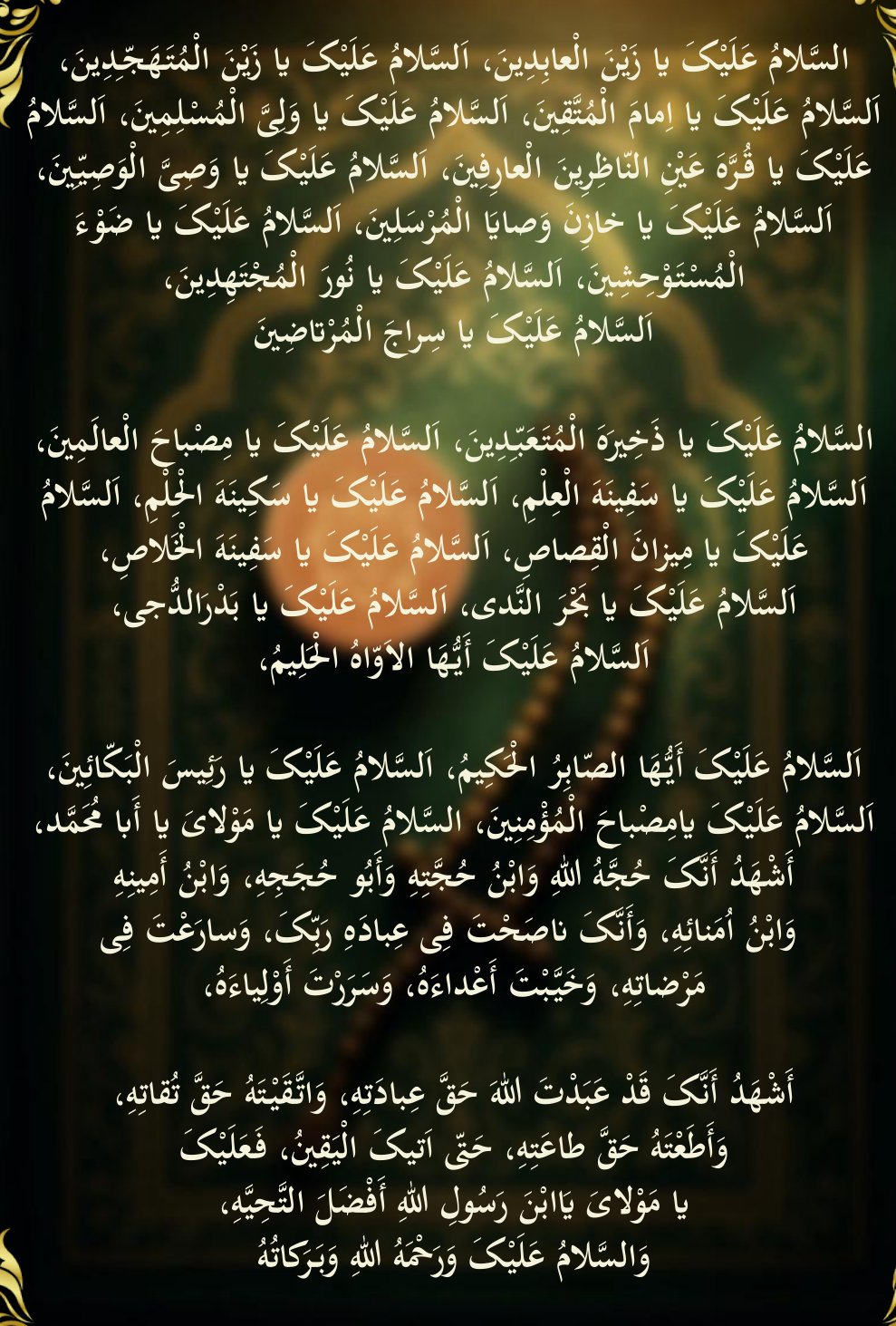
Peace be upon you, O adornment of the worshippers. Peace be upon you, O beauty of the night vigil-keepers.
Peace be upon you, O leader of the pious. Peace be upon you, O guardian of the Muslims. Peace be upon you, O light of the gnostics’ eyes. Peace be upon you, O successor of the successors. Peace be upon you, O keeper of the trusts of the divine messengers. Peace be upon you, O light for the fearful. Peace be upon you, O radiance of the devoted worshippers.
Peace be upon you, O shining lamp for the ascetics.
Peace be upon you, O provision and treasure of the worshippers.
Peace be upon you, O radiant lamp for all the worlds. Peace be upon you, O vessel of knowledge Peace be upon you, O source of serenity, forbearance, and patience. Peace be upon you, O one who clarifies the law of retribution. Peace be upon you, O ark of sincerity. Peace be upon you, O ocean of generosity. Peace be upon you, O shining moon in the dark night.
Peace be upon you, O man of prayer and patience.
Peace be upon you, O wise and steadfast one. Peace be upon you, O master of the weeping ones. Peace be upon you, O lamp of guidance for the believers.
Peace be upon you, O my master, O Aba Muhammad. I bear witness that you are the proof of God, the son of His proof, the son of His trustee, and the descendant of God’s entrusted ones. You strove in worship of your Lord with utmost sincerity and hastened to earn His pleasure. You brought despair to His enemies and joy to His friends. I bear witness that you fulfilled the true worship of God and observed the full right of piety and obedience to Him, until the moment you passed away. So, upon you, O my master, O son of the Messenger of God, be the best of God's blessings, peace, mercy, and grace.
The Noble Hadith of the Tablet of Jabir
Introduction to the Hadith
The well-known Hadith of the Tablet, which is also known by the name of Jabir ibn Abdullah al-Ansari due to its narration through him, is as follows:
Imam al-Sadiq (PBUH) narrates that one day his father requested Jabir ibn Abdullah al-Ansari to recount the incident of seeing the Tablet that was in the possession of his grandmother, Lady Fatimah (PBUH), and to describe the contents written upon it.
Jabir said: One day during the lifetime of the Messenger of God (PBUH&HF), I visited your mother, Lady Fatimah (PBUH), to congratulate her on the birth of Imam Hussain (PBUH). I noticed in her blessed hands a green tablet, which I thought was made of emerald. On this tablet, I saw a white script shining like the sun.
I said to her: May my father and mother be sacrificed for you! What is this tablet? Lady Fatimah (PBUH) replied: This is a Tablet that God, the Almighty and Exalted, gifted to His Messenger, Mohammad al-Mustafa (PBUH&HF). On this Tablet, the names of my father, my husband, my children, and the names of the successors and Imams from my descendants are written. My father, the Messenger of God (PBUH&HF), gifted it to me so that my heart may find joy by looking at it.
Then Lady Fatimah (PBUH) handed the Tablet to me. I read what was written on it and made a copy of it.
Jabir brought out a scroll made of fine leather, opened it, and showed it to my father. My father said to Jabir: O Jabir! Now look at the scroll you possess, and I will recite it for you from memory. Jabir looked at his scroll while my father recited the entire contents from memory. By God, not a single word of what my father recited differed from the scroll in Jabir’s hand. After finishing his recitation, Jabir said: I call upon the Great God as my witness that what I saw in the possession of Lady Fatimah (PBUH) was exactly what you have recited.
Authentication of the Hadith of Jabir ’ s Tablet The Hadith of the Tablet is among the traditions recorded in the most reliable Shia sources. Various supporting reports confirm the validity of this narration and further enhance its credibility and value.
This narration was transmitted by Thiqatu’l-Islam al- Kulayni in al-Kafi through trusted narrators. (al-Kafi, Vol. 1, p. 527)
In addition to al-Kulayni, other scholars have also regarded this narration as authentic and have recorded it in their books, either with the same chain of narrators or through alternative chains.
These include: al-Nu’mani in al-Ghaybah, al-Shaykh al-Saduq in ‘Uyun Akhbar al-Ridha, al-Shaykh al- Mufid in al-Ikhtisas, and al-Shaykh al-Tusi in al- Ghaybah.
al-Ghaybah, p. 62; Kamal al-Din, Vol. 1, p. 308; ‘Uyun Akhbar al-Ridha (peace be upon him), Vol. 1, p. 41; Jami‘ al-Akhbar, p. 18; Bihar al-Anwar, Vol. 36, p. 195; al-Ikhtisas, p. 210; al-Ghaybah, p. 143.
Furthermore, this narration, whether in full or in part, with or without chains of transmission, has been cited in other works such as: al-Ihtijaj, Irshad al-Qulub, Ta’wil al-Ayat, Taqrib al-Ma‘arif, Fadail Fadl ibn Shadhan, Manaqib Ibn Shahr Ashub, Kashf al- Ghummah, al-Fusul al-Mukhtarah, al-Sirat al- Mustaqim, al-Irshad of Shaykh al-Mufid, and others.
For access to the full text of the hadith, refer to the mentioned sources.
The Virtues of the Imams of al - Baqi ‘
(PBUTh) in the Noble Hadith of the Tablet His Eminence, Imam of al-Baqi‘, Ali ibn al- Hussain (PBUTh)
Imam Zayn al-‘Abidin, Ali ibn al-Hussain (PBUTh) is the second Imam laid to rest in Jannat al-Baqi‘.
In the Divine Hadith of the Tablet, God, the Almighty and Exalted, spoke of the lofty status of this great Imam as follows:

Ali is the Master of the Worshippers and the Adornment of My past Awliya (Saints).
This lofty status of Imam al-Sajjad (PBUH) has also been reported through the luminous words of his noble grandfather. In a narration, it is mentioned that the Messenger of God (PBUH&HF) pointed to Imam Hussain (PBUH) and said:
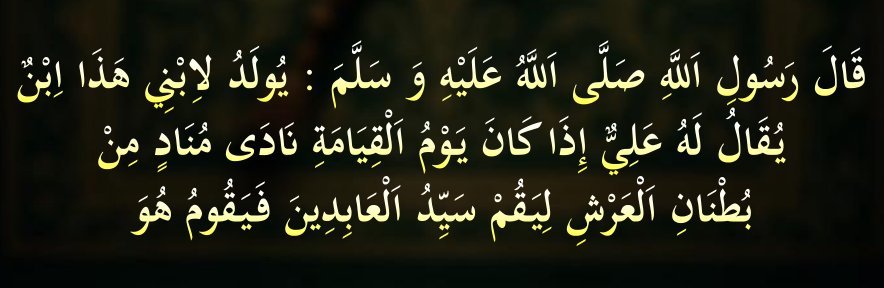
From this son of mine, a child will be born who will be named 'Ali'.
When the Day of Judgment comes, a caller from the Throne will proclaim: 'Let the Master of the Worshippers stand! ’ At that moment, he will rise.
( Ithbat al - Huda , Vol. 4 , p. 61 )
Imam al-Sajjad (PBUH) is the Master and Leader of all worshippers. Now, it is important to understand: what does worship mean from the perspective of the Two Weighty Things (Thaqalayn — the Qur'an and Ahlul Bayt)? Does worship merely mean standing in the prayer niche (mihrab) and engaging in supplication and whispered prayers with the Lord? From the perspective of the verses of the Noble Qur'an and the statements of those who are the Speaking Qur'an, the true essence of worship is the recognition and knowledge of Almighty God.

I did not create the jinn and mankind except that they worship Me [and through this, they may attain perfection and draw near to Me].
(Qur ’ an, Surah al - Dhariyat , 51:56 )
Imam Aba Abdullah al-Hussain (PBUH) said:
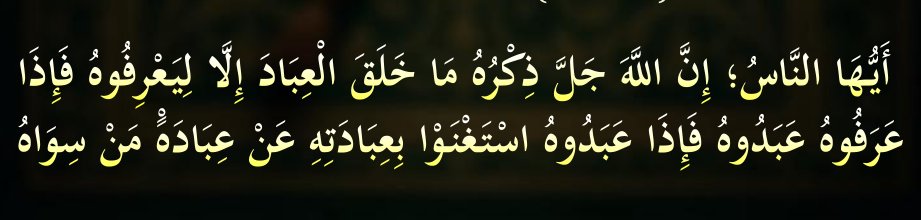
God, the Exalted, did not create His servants except that they may know Him.
When they come to know Him, they worship Him.
And when they worship Him, they will abandon the worship of all others besides Him.
A man asked: O son of the Messenger of God (PBUH&HF), may my father and mother be sacrificed for you! What is the meaning of knowing God? The Imam (PBUH) replied:

The people of every era are required to know and recognize the Imam of their own time, whose obedience is obligatory upon them.
(Tafsir Ahlul Bayt (PBUH), Vol. 15 , p. 154 / ‘ Ilal al - Shara ’ i ‘ , Vol. 1 , p. 9 / Nur al - Thaqalayn )
As Imam Hussain (PBUH) stated, the purpose of creation is the knowledge of God, and this is attained through the knowledge of the Most Beautiful Names of God (Asma’ Allah al-Husna) — that is, through the Imams of Ahlul Bayt (PBUH). Ali ibn al-Hussain (PBUH) is given the title “Sayyid al- ‘Abideen” (Master of the Worshippers) in this saying of God, the Almighty. This noble Imam is the leader and master of all worshippers, and through his blessed existence, the true meaning of servitude and worship has been clarified for the servants of God, and through him, God Almighty is truly worshipped.
A man asked: O son of the Messenger of God (PBUH&HF), may my father and mother be sacrificed for you! What is the meaning of knowing God? The Imam (PBUH) replied:

Through our worship, God is worshipped; and had it not been for us, God would not have been worshipped.
( Al - Kafi , Vol. 1 , p. 144 , Bahr al - ‘ Irfan , Vol. 15 , p. 47 )
The Virtues of the Imams of al - Baqi ‘
(PBUTh) in the Noble Hadith of the Tablet His Eminence, Imam of al-Baqi‘, Ali ibn al- Hussain (PBUTh)

Ali is the Master of the Worshippers and the Adornment of My past Awliya (Saints).
Ali is the adornment of My past Awliya (Saints). Adornment (Zeenat) refers to something that is inherently beautiful; that is, its beauty is intrinsic to its nature. Anything that comes into contact with it can adorn and beautify itself through it. Therefore, everything has its own form of adornment, by which it becomes enhanced, valuable, and precious. Imam al-Sadiq (PBUH) has described good character (akhlaq hasanah) as the adornment of Islam:

Good character among people is the adornment of Islam. (Mishkat al - Anwar fi Ghurar al - Akhbar, p. 240 )
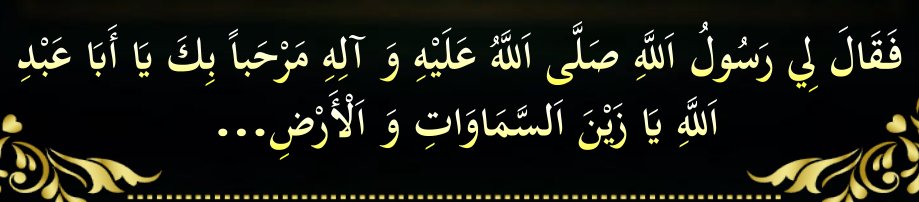
In a narration from Imam Hussain (PBUH), it is mentioned that the Messenger of God (PBUH&HF) said to him: Welcome to you, O Aba Abdillah! O adornment of the heavens and the earth…
The Virtues of the Imams of al - Baqi ‘
(PBUTh) in the Noble Hadith of the Tablet His Eminence, Imam of al-Baqi‘, Ali ibn al- Hussain (PBUTh)

Ali is the Master of the Worshippers and the Adornment of My past Awliya (Saints).
Ali is the adornment of My past Awliya (Saints). Adornment (Zeenat) refers to something that is inherently beautiful; that is, its beauty is intrinsic to its nature. Anything that comes into contact with it can adorn and beautify itself through it. Therefore, everything has its own form of adornment, by which it becomes enhanced, valuable, and precious. Imam al-Sadiq (PBUH) has described good character (akhlaq hasanah) as the adornment of Islam:

Good character among people is the adornment of Islam. (Mishkat al - Anwar fi Ghurar al - Akhbar, p. 240 )
In a narration from Imam Hussain (PBUH), it is mentioned that the Messenger of God (PBUH&HF) said to him: Welcome to you, O Aba Abdillah! O adornment of the heavens and the earth. (Al-Khara’ij wa al-Jara’ih, Vol. 2, p. 550)

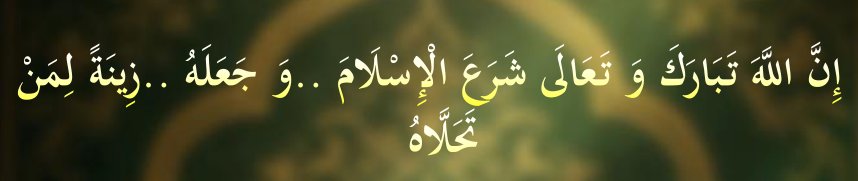
What truly adorns the servants of God is the Wilaya (Divinely-Appointed Guardianship) of the Ahlul Bayt (PBUH). As Amir al-Mu’minin (PBUH) has stated, Islam and faith are the adornment of the servants of God (Kitab Asrar Aal Muhammad, Vol. 2, p. 618):
Imam Ali (PBUH) is reported to have said:
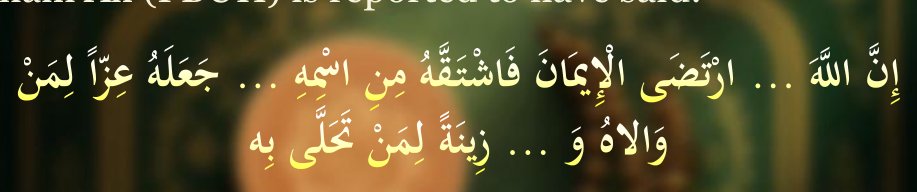
Indeed, God … has chosen faith and derived it from His Own Name … He made it a source of honor for those who uphold it … and an adornment for those who adorn themselves with it.
( Bihar al - Anwar, Vol. 65 , p. 382 )
For the true essence of Islam and faith is submission to the Wilaya (Divinely-Appointed Authority) of the Pure Imams (PBUH).
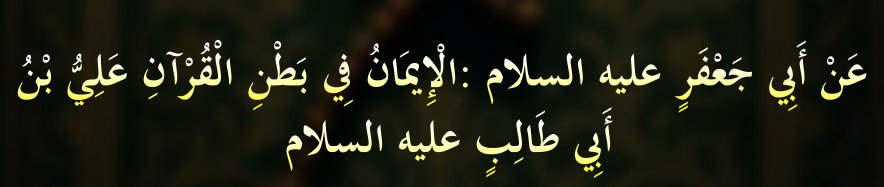
Faith (Iman) within the core of the Qur ’ an is Ali ibn Abi Talib (PBUH). ( Bihar al - Anwar, Vol. 35 , p. 348 )
Imam Baqir (PBUH) said:

Regarding God ’ s saying: “ Indeed, the religion with God is Islam ” — he (PBUH) said: it means submission to the wilayah of Ali ibn Abi Talib (PBUH). ( Manaqib Aal Abi Talib (PBUH), Vol. 3 , p. 95 )
In this passage of the Divine Hadith of the Tablet, God, the Most Glorious, describes Ali ibn al-Hussain (PBUH) as the adornment of the former friends (Awliya) of God.
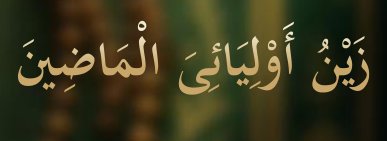
The statement of God Almighty in this noble Hadith indicates that the sacred beings of the Household of God (PBUH) are the very essence of 'adornment' (Zeenat) in the world, and the friends (Awliya) of past divine religions are adorned through them. As Imam al-Sadiq (PBUH) said:
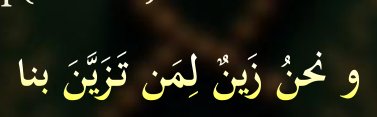
We are the source of adornment for those who adorn themselves through us.
( Bihar al - Anwar, Vol. 65 , p. 153 , ‘ Awalim al - ‘ Ulum , Vol. 20 , p. 776 )

misbah-inc.com