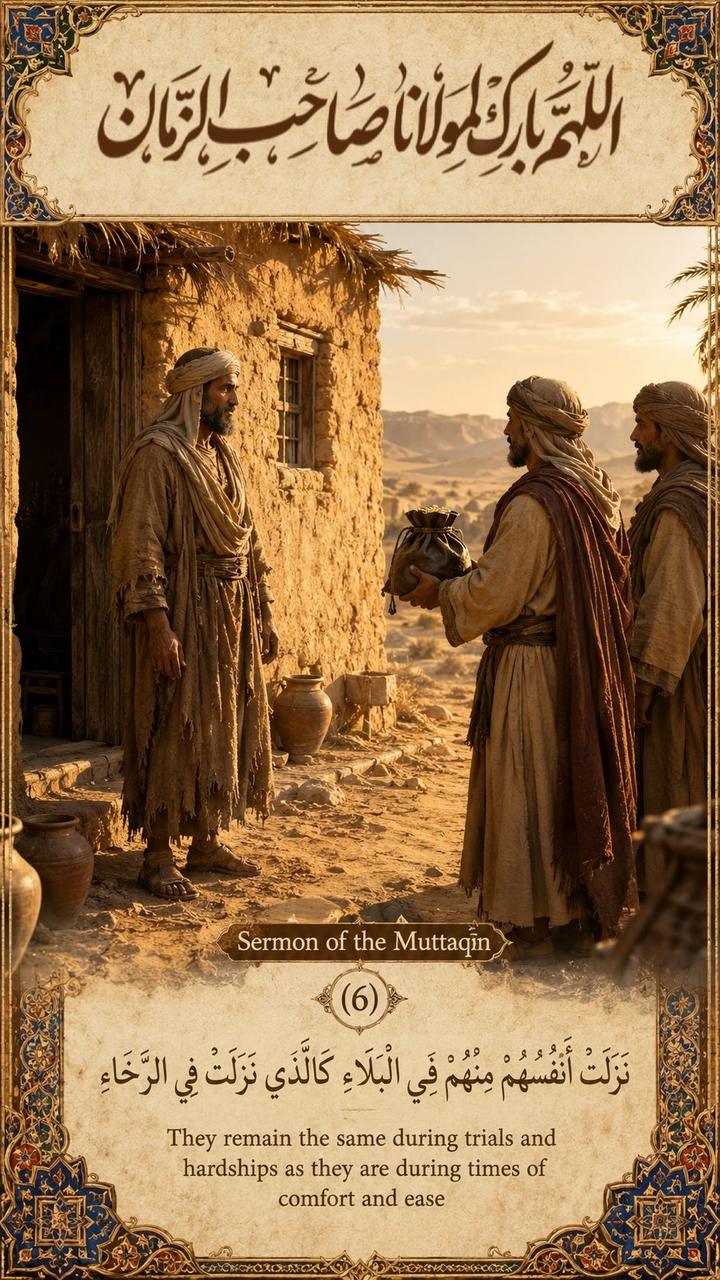
Sermon of Muttaqin, Part 6 — They remain the same during trials and hardships as times of comfort and ease
The Sixth Characteristic of the God-Conscious (Muttaqīn), Based on the Sermon of the Pious
They remain the same in hardship as they are in ease:
“The people of piety remain the same during trials, hardships, and changing circumstances as they are during times of comfort and ease.”
It is narrated from Imam Sadiq (PBUH):
“Uthman sent two of his freed servants to Abu Dharr, carrying with them two hundred dinars. He instructed them:
‘Go to Abu Dharr and tell him: Uthman sends you his greetings and says, “Take these two hundred dinars and use them to meet your needs.”’
Abu Dharr asked:
“Has Uthman given this same amount to any other Muslim?”
They replied:
“No.”
He said:
“I am only one of the Muslims. Whatever is sufficient for the Muslims is sufficient for me.”
They then said:
“He says: ‘This money comes from my own lawful personal wealth. By Allah, besides Whom there is no god, it has not been mixed with anything unlawful, and I have sent it to you only from lawful earnings.’”
Abu Dharr replied:
“I have no need for it. This morning I awoke as one of the wealthiest people.”
They said:
“May Allah grant you well-being and righteousness. We do not see anything in your house, whether little or much, from which you could benefit.”
Abu Dharr answered:
“Indeed, beneath this saddlecloth that you see are two loaves of barley bread that have been with me for several days. What need do I have for these dinars?
No, by Allah! I will never accept them until Allah knows that I am content whether I possess little or much.
I have found all the wealth I need through the wilayah of Ali ibn Abi Talib (PBUH) and his Ahl al-Bayt (PBUT)—those who are rightly guided, pleasing to Allah, who guide people with the truth and judge with justice.
I also heard the Messenger of Allah (PBUH&HP) say:
‘It is disgraceful for an old man to be a liar.’
Therefore, return this money to him and inform him that I have no need for it, nor for anything he possesses, until I meet my Lord. Then Allah will judge between him and me.”
References
- Bihar al-Anwar: The جامع Collection of the Traditions of the Pure Imams (PBUT), Vol. 22, p. 398.
- Rawdat al-Wa’izin, Vol. 2, p. 284.
- Ikhtiyar Ma’rifat al-Rijal (Rijal al-Kashshi), Vol. 1, p. 27.