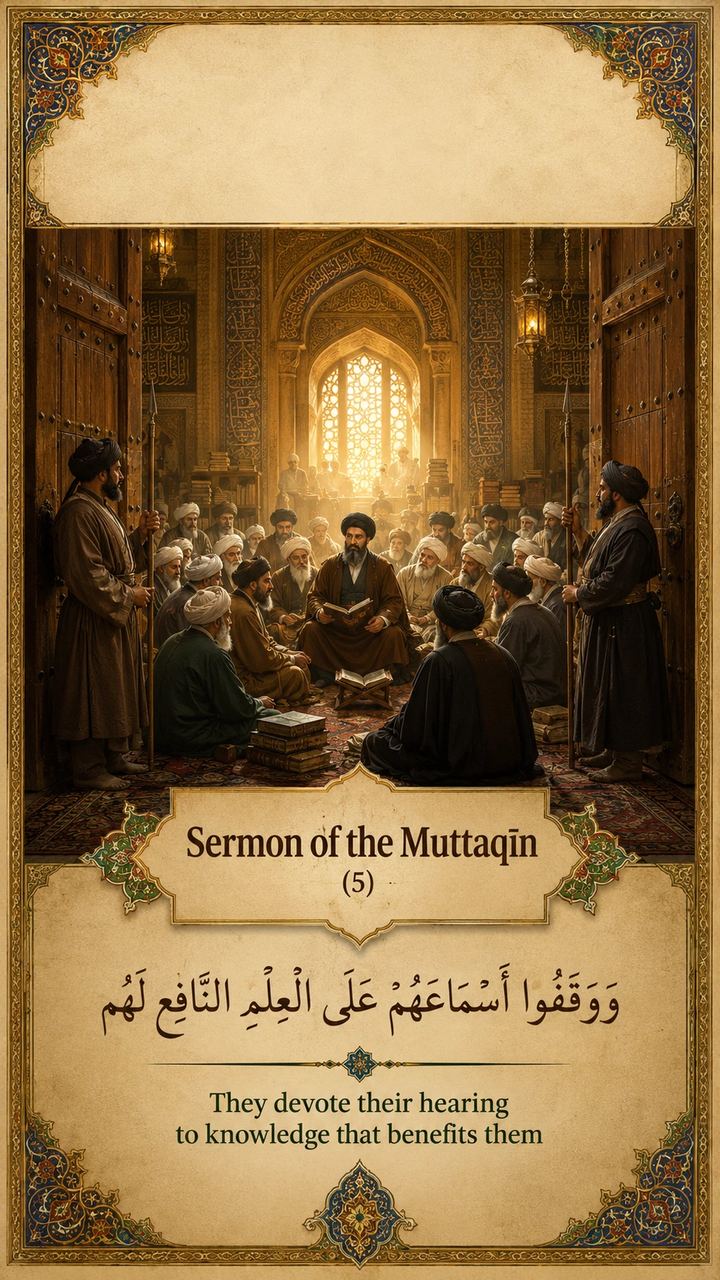
Sermon of Muttaqin, Part 5 — They devote their hearing to knowledge that benefits them
The Fifth Characteristic of the God-Conscious (Muttaqīn), Based on the Sermon of Muttaqīn by Amir al-Mu’minin (pbuh)
Their ears are devoted to beneficial knowledge:
“They dedicate their hearing solely to knowledge that benefits them.”
Muhaddith Nuri (may Allah have mercy on him) writes:
I heard from the righteous scholar, Shaykh Hasan Mazandarani, that I was once present in the lesson of the great jurist, Sahib al-Jawahir. He said:
“Last night I saw in a dream that a magnificent gathering had been convened. Many scholars were present, and gatekeepers stood at the entrance. I sought permission and entered.
I saw that all the great scholars of previous generations were assembled, and at the head of the gathering sat Allamah Majlisi.
I was astonished that he had been given precedence over everyone else, so I asked the gatekeepers the reason.
They replied:
‘Among the Imams (PBUT), Allamah Majlisi is known as “Bāb al-A’immah” (The Gateway to the Imams). He attained this lofty rank because he established the custom of Chāvushī—encouraging and announcing pilgrimages for the visitors of the holy shrines.’”
Muhaddith Nuri continues:
“With the spread of the tradition of Chāvushī, people became encouraged and inspired to visit the holy Imams (PBUT). It is also possible that what is intended is the great body of writings authored by Allamah Majlisi, through which the narrations and teachings of the Ahl al-Bayt (PBUT) were widely disseminated, guiding people toward the Household of Purity.“¹
Ayatollah Kazim Qarubi Tabrizi (may Allah have mercy on him) relates:
“One of our teachers narrated from Agha Zia al-’Iraqi:
‘In the original, uncorrupted Torah it is stated that at a time when the religion of the Seal of the Prophets would begin to decline, a man from among the followers of that Prophet, by the name of Majlisi, would revive that religion through his tireless efforts.’“²
References
- Dar al-Salam, by Muhaddith Nuri, Vol. 2, p. 224.
- Sinā-ye Ma’rifat, p. 200.