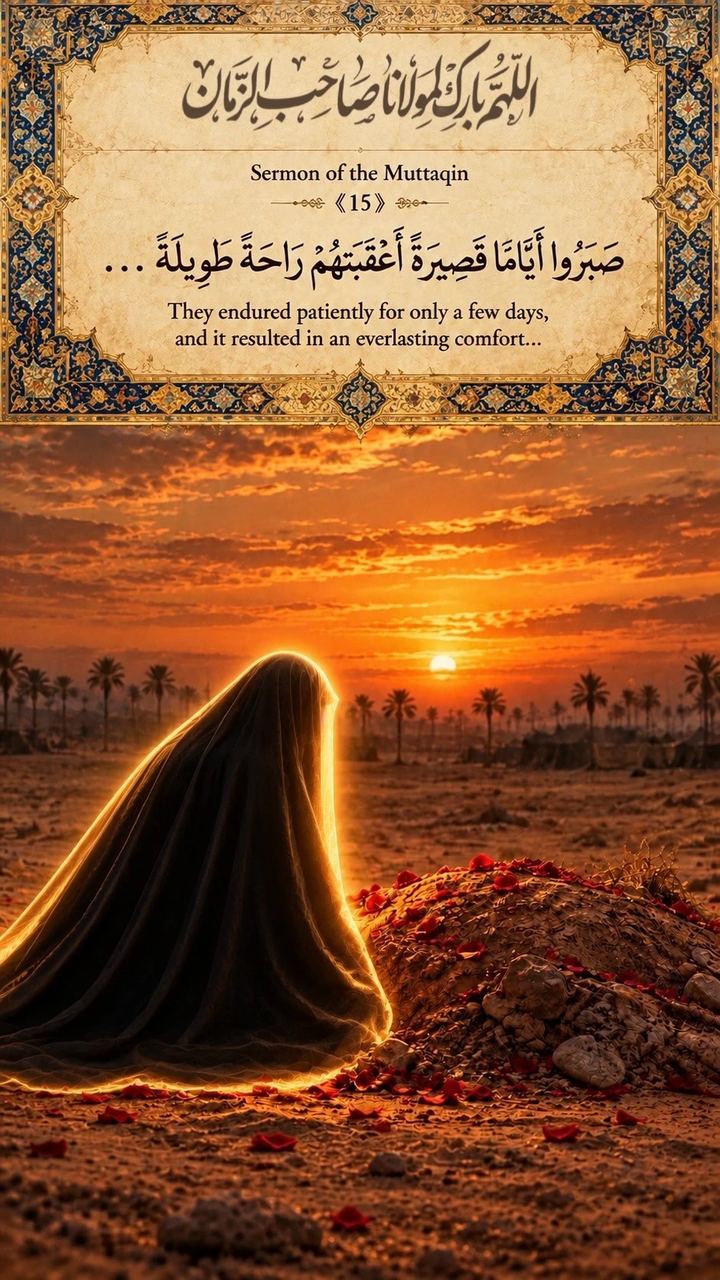
Sermon of Muttaqin, Part 15 — They endured patiently for only a few days, and it resulted in an everlasting comfort
Amir al-Mu’minin, peace be upon him, states about the fifteenth characteristic of the God-conscious:
“They endured patiently for only a few days, and it resulted in an everlasting comfort—a profitable trade which their Lord graciously prepared for them.”
One of the most beautiful manifestations of this quality can be seen in the life of Lady Rubab, peace be upon her.
Lady Rubab was the wife of Imam Hussein, peace be upon him, and the mother of Lady Sukaynah.
She was taken captive to Damascus together with the other members of the Household of Imam Hussein. Afterward, she returned to Madinah.
She lived only one year after the martyrdom of Imam Hussein.
Throughout that year, she refused to remain beneath the shade of any roof. She stayed exposed to the sun, consumed by grief over the tragedy of Karbala, until the sorrow gradually weakened her body and she returned to her Lord.
It is also narrated that she remained beside the grave of Imam Hussein for an entire year before returning to Madinah, where she soon passed away from the overwhelming weight of grief and longing.
Steadfastness is remaining firm upon the path of Wilayah.
Imam al-Sadiq, peace be upon him, stated in explaining the verse:
It means that if they had remained steadfast upon the Wilayah, when Allah took the covenant from the descendants of Adam on the Day of Alast, We would surely have given them to drink from the pure, sweet, and refreshing water.
References
- Al-Kamil fi al-Tarikh, Vol. 2, p. 579.
- Jawahir al-Matalib, Vol. 2, p. 295.
- Bihar al-Anwar, Vol. 24, p. 28.