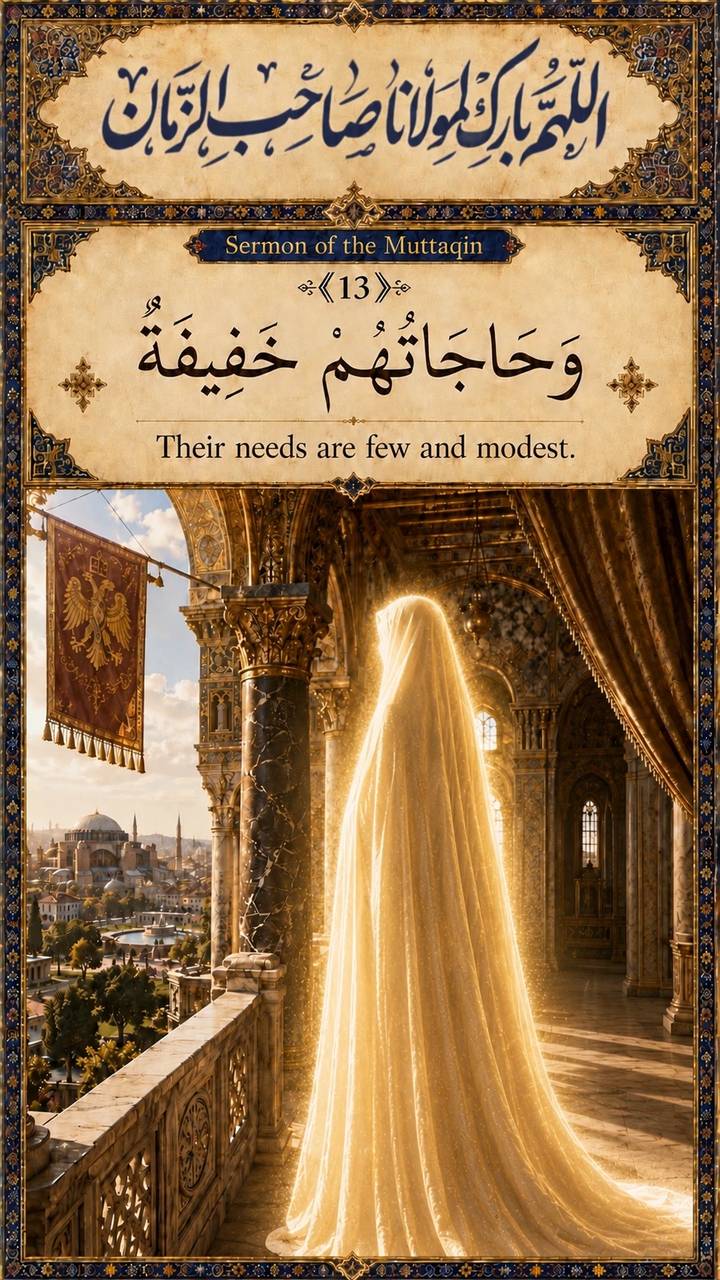
Sermon of Muttaqin, Part 13 — Their needs are few and modest
The thirteenth characteristic of the pious, based on the Sermon of the Pious (Khutbat al-Muttaqin):
Their needs are few: "And their needs are light";
Their needs are modest and minimal.
Regarding her lineage, Lady Narjis Khatun (peace be upon her) stated:
"I am Malika, daughter of Yashu'a, son of Caesar, the King of Rome; and my mother is of the lineage of the Apostles, tracing her ancestry back to Simon, the successor of Christ."
And regarding her status within the royal family, she said:
"My grandfather, Caesar of Rome, decided to marry me to his nephew when I was thirteen years old, and for this ceremony, he assembled the state dignitaries, army commanders, bishops, monks, and Roman nobles in the royal palace."
Yet, destiny unfolded in such a way—and the will of the Lord was realized— that she would be taken captive in a war. Regarding the beginning of her captivity, she said:
«Imam Hasan al-Askari (AS) informed me that the Roman army would march to war against the Muslims and instructed me to accompany them disguised as a servant. I followed his instructions; along the way, the vanguard of the Muslim army took us captive, and the events unfolded just as you saw.»
Regarding the concealment of her identity, she said:
«Until this moment, no one other than you has known that I am the daughter of the King of Rome. When I was asked my name, I concealed my identity and said: "Narjis."»
Bishr ibn Sulayman recounts:
"When I brought her to the city of Samarra (Askar), I took her into the presence of my master, Abu al-Hasan (peace be upon him)..."
After welcoming Lady Narjis (peace be upon her), Imam Hadi (peace be upon him) said to Lady Hakimah Khatun (peace be upon her):
"Take her to your home and teach her the religious obligations and traditions; for she is the wife of Abu Muhammad [Imam Hasan al-Askari] and the mother of the Qa'im (peace be upon him)."
And thus, a princess became a captive and the mother of an Imam—a princess who, indifferent to worldly vanities and seeking only the pleasure of the Lord, willingly endured the hardships inflicted by enemies. Peace be upon the mother of the Imam.
References
- Al-Ghaybah (by al-Tusi), Vol. 1, p. 208;
- Bihar al-Anwar, Vol. 51, p. 6.