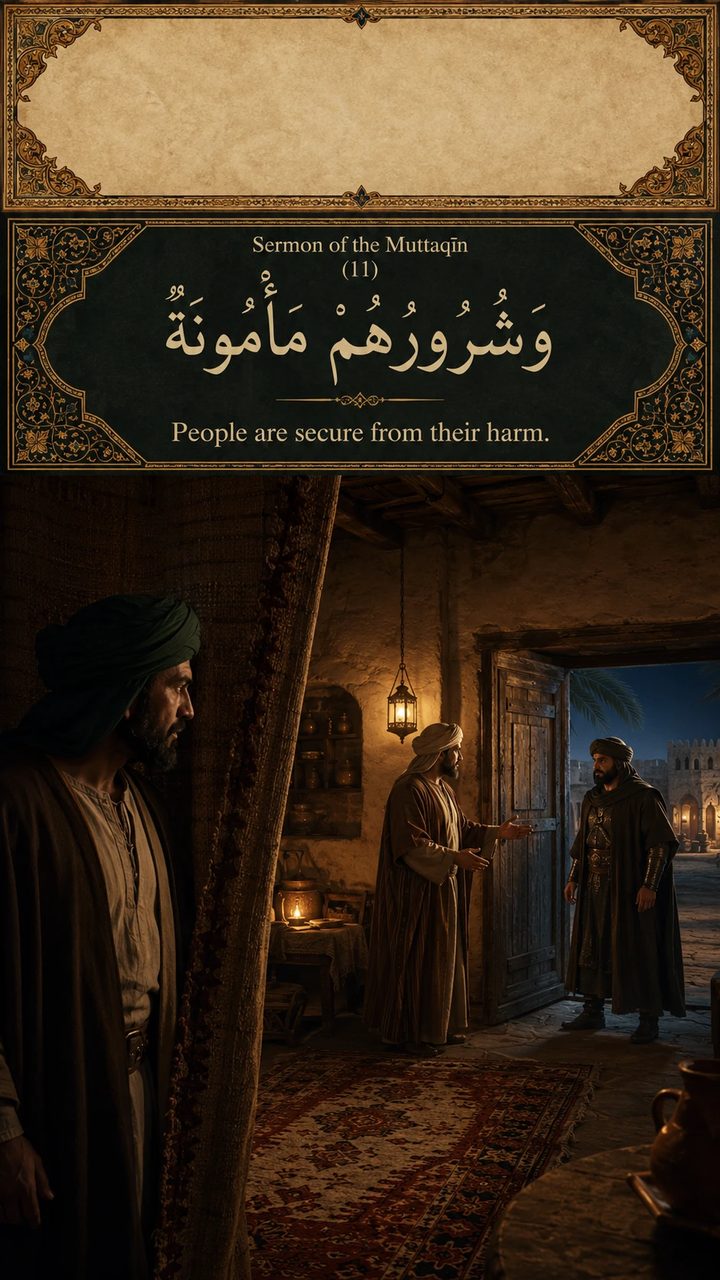
Sermon of Muttaqin, Part 11 — People are secure from their harm
The Eleventh Characteristic of the God-Conscious (Muttaqīn), Based on the Sermon of Muttaqīn by Amir al-Mu’minin (pbuh)
People are safe from their harm:
“People are secure from their evil and harm.”
Imam al-Sadiq (PBUH) said:
“A believer is the brother of another believer. He is his eye and his guide. He does not betray him, oppress him, deceive him, nor does he make a promise to him and then break it.”
The Messenger of Allah (PBUH&HP) also said:
“A believer is one whom people trust with their lives and their property.”
During the days when Muslim ibn Aqil (PBUH) was taking refuge in the house of Hani ibn ’Urwah (PBUH), a rare opportunity arose to bring an end to the rule of Ubayd Allah ibn Ziyad (LA).
When Ibn Ziyad came to visit the ailing Hani in his home, some of Muslim’s companions urged him to seize the opportunity and kill the tyrannical governor.
Sharik repeatedly signaled to Muslim through subtle gestures and coded verses, encouraging him to act.
Yet Muslim never drew his sword.
On one hand, Hani did not consent to Ibn Ziyad’s blood being shed inside his home.
On the other hand, Muslim acted upon the words of the Messenger of Allah (PBUH&HP), who said:
“Whoever grants a person safety regarding his life and then kills him, I disassociate myself from the killer—even if the one who was killed was an unbeliever.”
References
- Al-Kafi, Vol. 2, p. 166.
- Kanz al-’Ummal, Hadith 739.
- Tarikh al-Tabari, Vol. 5, p. 363.
- Al-Kamil fi al-Tarikh, Vol. 4, p. 27.